Roen Veck reached the top of the stair for the sixth time and found the baker's yard waiting below him.
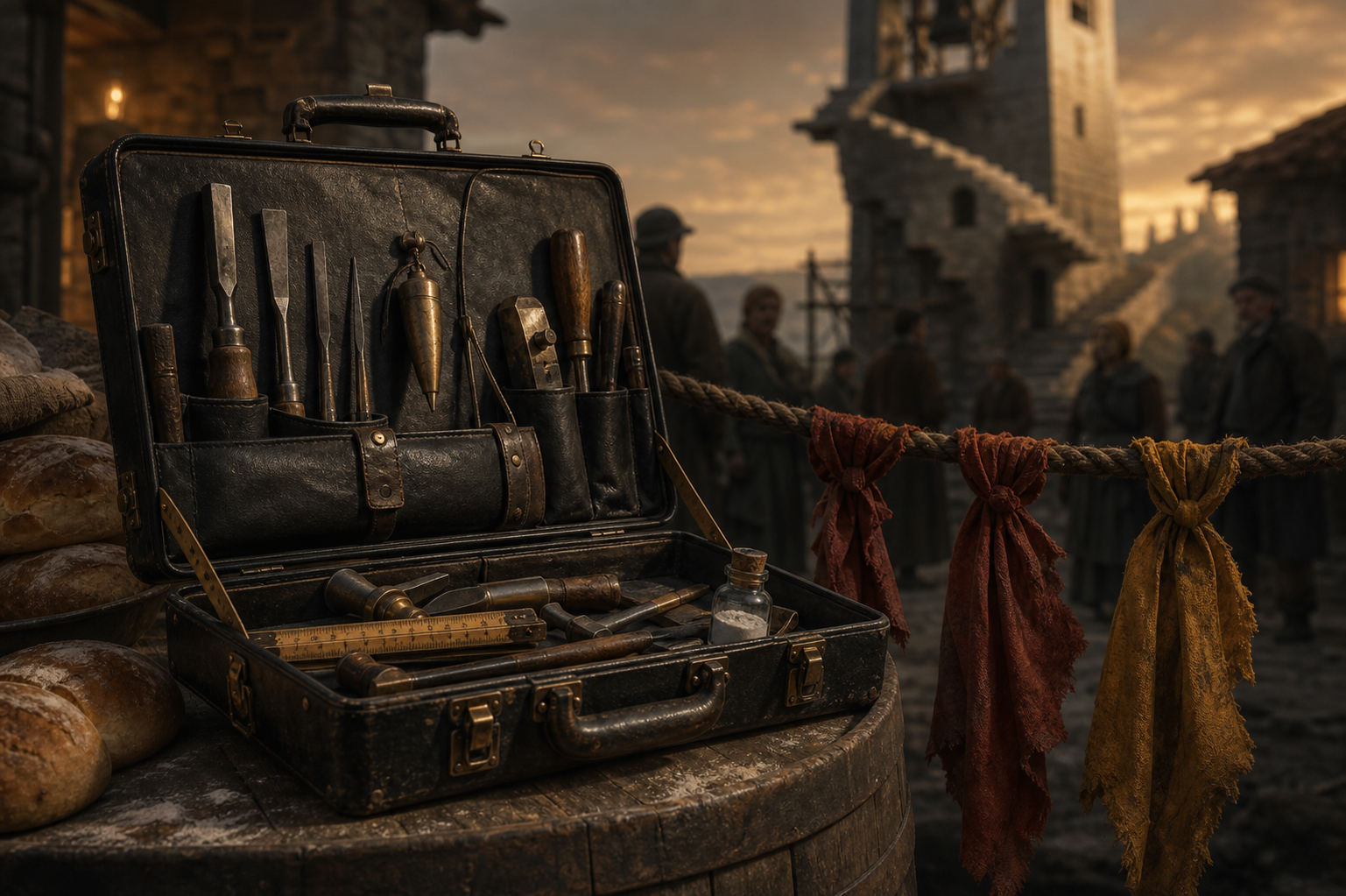
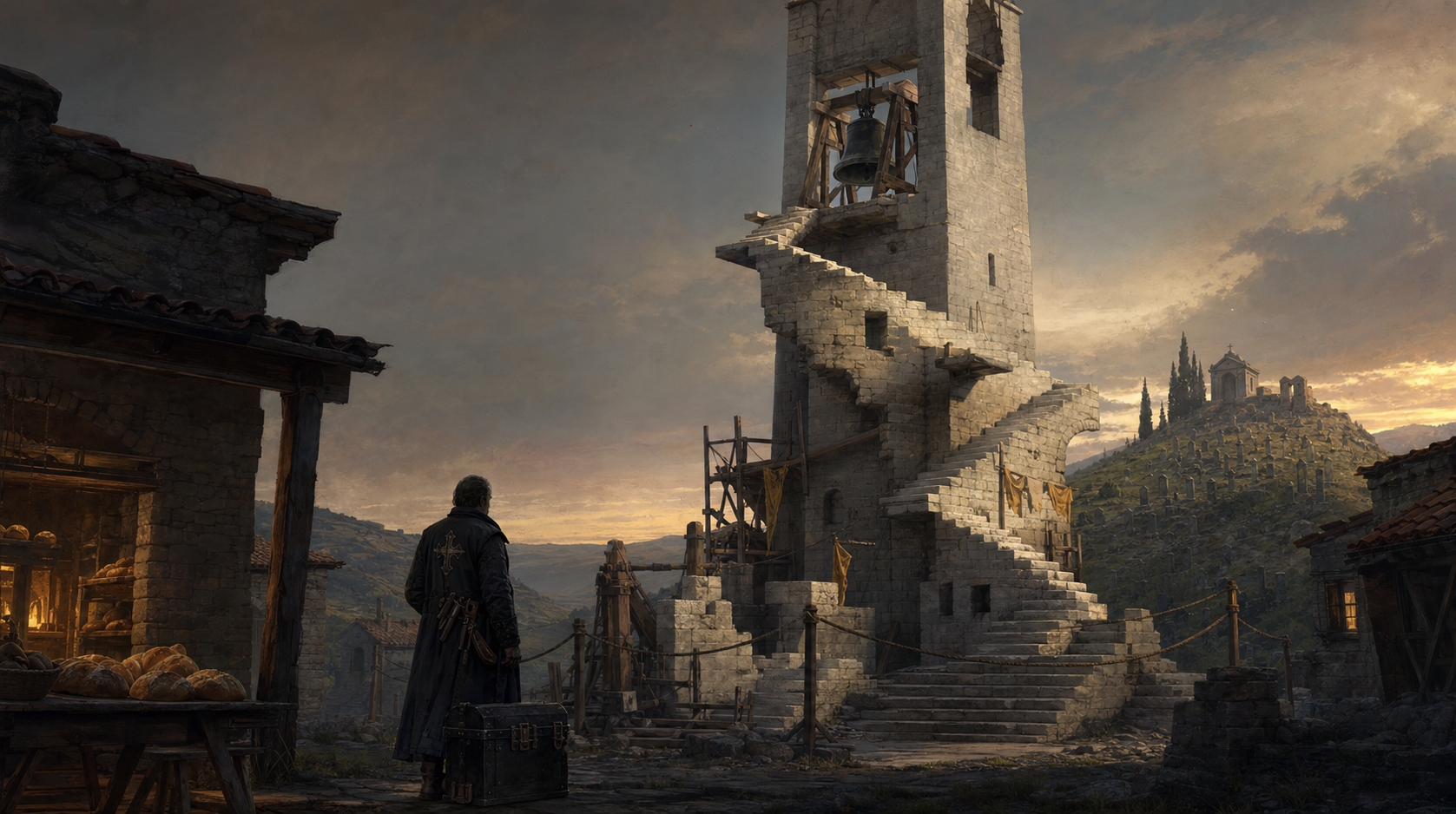
The villagers had put a rope across the lane to keep children out. It sagged between two flour barrels and a shrine-stone with its face worn smooth by weather. Someone had tied three warning rags to it. Two red. One yellow. The yellow rag meant money had been spent and the village wanted strangers to notice.
Roen put his boot on the last step again.
The yard tilted. The smell of hot rye came up through the stones. A boy on the far side of the rope stopped chewing his thumbnail and stared as Roen descended from a stair that should have led to the bell loft.
"Well?" the mayor called.
Roen did not answer at once. He counted the risers with his eye, not his feet. Seventeen visible from the lane. Twenty-one from the first landing. Thirty-two if he started from the tower door. The mason had cut them from pale fieldstone and dressed the edges with a narrow chisel. Good work, mostly. Better than the village had paid for, likely.
The problem sat in the turn.
Not sat. Roen corrected himself. Stone did not sit unless a man had put it there.
He stepped over the rope. The villagers shifted back from him, all except the mayor, who held her ground with the stiff bravery of someone who had already paid half in advance.
"Master Veck," she said. "You have been up there near an hour."
"Twelve minutes."
"It rang noon twice."
"That happens."
The mayor's mouth tightened. She was a narrow woman in a green coat patched at both elbows, with a silver chain of office polished brighter than the buttons beneath it. Her name had been on the writ. Mara? Maret? Roen waited for the shape to come back and got only the blank place where it had been.
He had closed seven works in twelve years. Small ones, mostly. A bridge that made carts arrive before they left. A cradle-song that put fathers to sleep and mothers on their feet for three days. A boundary wall in Velsa that moved one handspan east every rain.
Names went first.
"The turn between the second and third landing is false," he said. "Your mason changed his mind there."
The mayor glanced toward the tower. "Changed it how?"
"He meant to bring the stair against the north wall. Then he cut the next set for the east. Halfway through the work he went back to the first plan."
"Because he died."
"No. Before that."
One of the older men crossed himself by touching thumb to brow, throat, and breastbone. Old Calendar habit. The priest beside him pretended not to see.
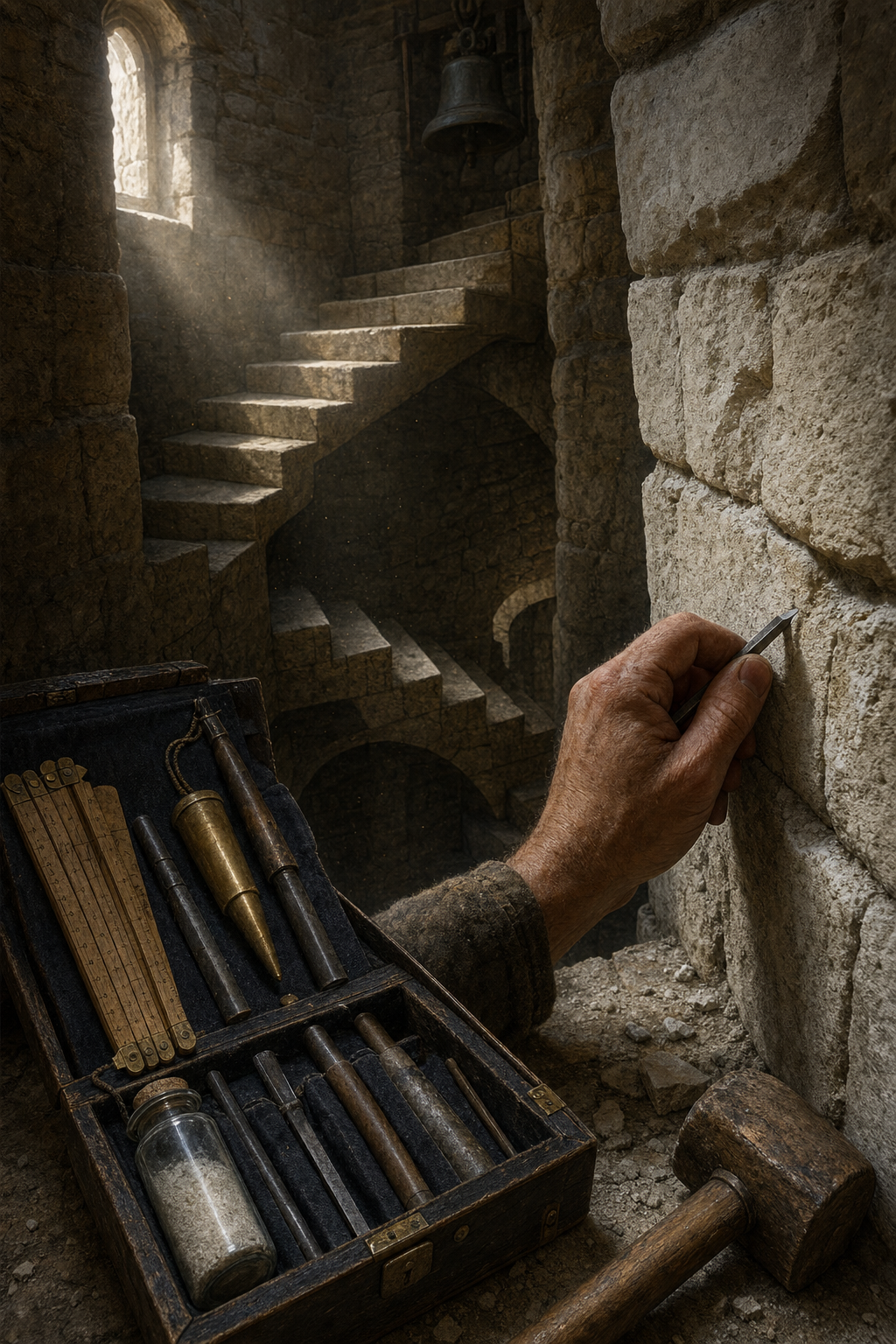
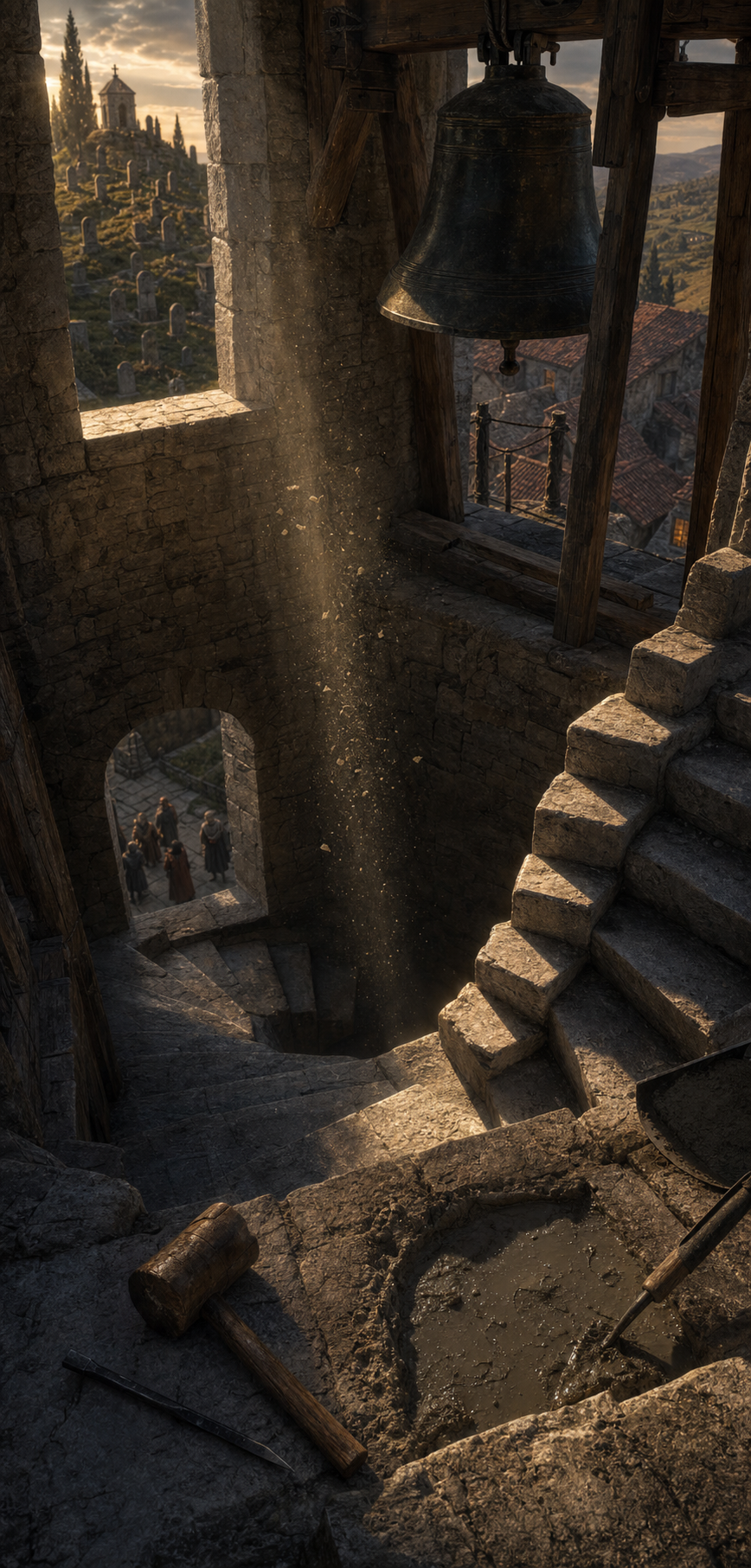
The stair belonged to the unfinished bell tower of Saint Avren's, though the village had stopped using the saint's name after the Republic took the parish lands and leased them back at a better rate. Father Pell still said Saint Avren when he thought no one from the tax office was listening. Forty-three years ago, Master Dollen Parr had fallen from the second scaffold with the last six stones unlaid and the bell still on the ground. Since then, the tower stair returned climbers to whichever place in the village they least expected to be.
In summer, children used it for dares.
In winter, old women used it to avoid the hill.
In March, a groom had climbed to fetch a pigeon and come down in his former sweetheart's kitchen two hours before his wedding. The bride's father had broken his nose. The village had then discovered that jokes became less funny when they interfered with dowries.
"Can you finish it?" the mayor asked.
Roen looked at the tower.
The top six stones waited beside the yard, stacked under canvas. The old mason's mark had been scratched into each hidden face: a hooked D inside a square. Dollen Parr had expected to come back from dinner and set them before rain. He had left his mallet on the fifth landing. No one had touched it since, because even fools sometimes had correct instincts.
"Yes."
The priest breathed out too loudly.
"Today?" the mayor said.
"If no one interrupts me."
The boy by the rope stopped chewing. "What happens if they do?"
Roen looked at him.
The boy took a step behind the baker.
"They may get where they are going," Roen said. "That would be careless."
The mayor frowned as if deciding whether she had paid for reassurance and been shorted. "You said in your letter there would be conditions."
"There are always conditions."
"Name them."
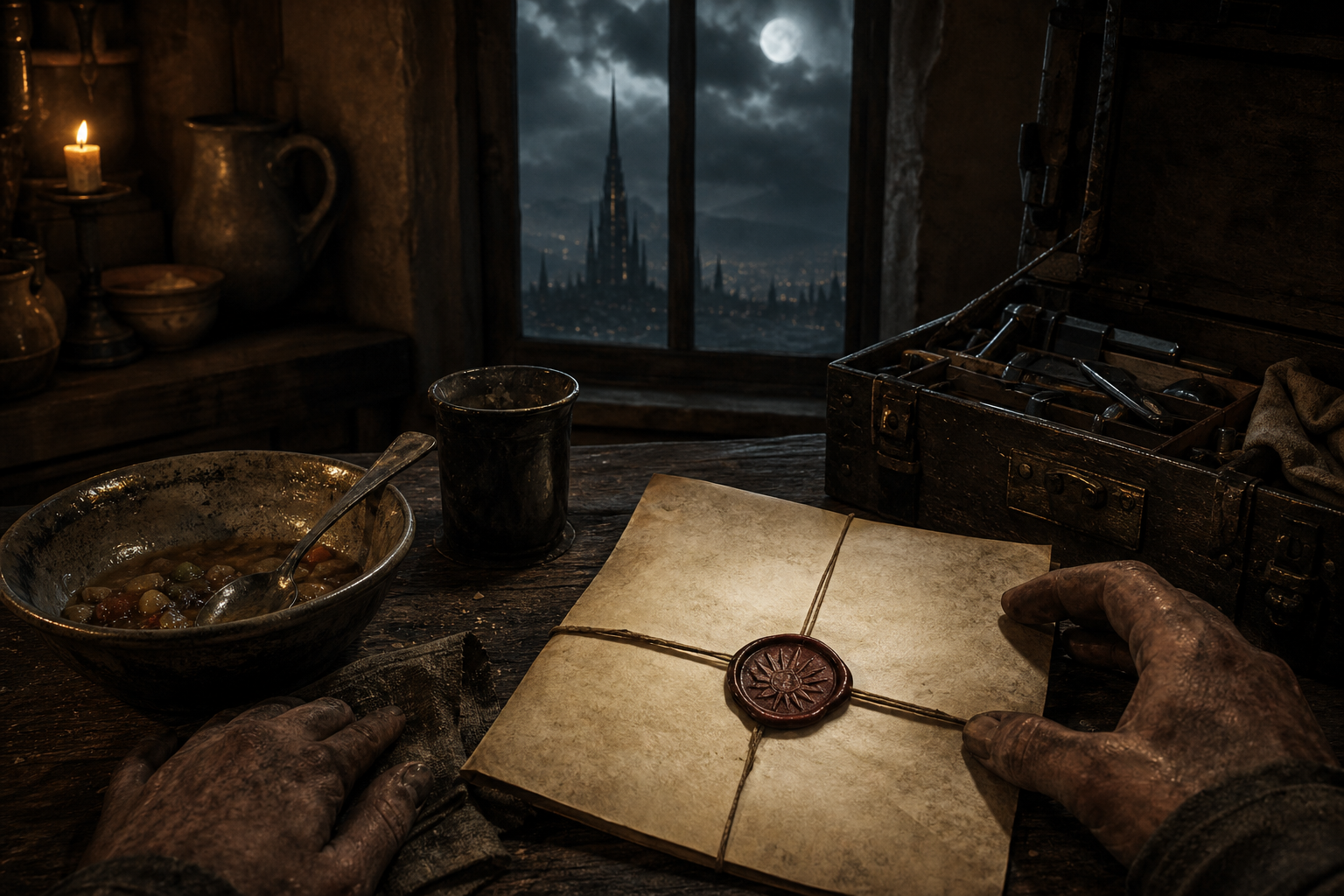
Roen unbuckled the black case from his shoulder and set it on the baker's flour barrel. The villagers watched with the same hungry caution people gave knives, coffins, and tax seals. He opened the case.
Inside lay the closer's kit.
It did not look like enough to frighten anyone. A folding rule. A thumb plane. Three chisels of different cuts. A brass plumb weight. Needles. Wire. A vial of powdered lime. A narrow hammer with a face no wider than a coin. The rest changed according to the work and according to the hand reaching for it. Today the kit smelled faintly of wet mortar, though Roen had cleaned it the night before.
"No one enters the tower," he said. "No one rings the handbell. No one speaks the dead man's name once I begin."
The priest raised his chin. "It is my duty to say the rite."
"Say it now."
"The rite belongs at the ending."
"Then hire a priest to close it."
The baker made a small sound and looked at his shoes.
The mayor's chain clicked against a button as she turned. "Father Pell, you will say what is needed now."
Father Pell's thumb moved over the first knot of his prayer cord and stopped there. "The Church cannot be ordered in a matter of souls."
"No," Roen said. "But the stair can be left as it is."
That moved the villagers. Not much. A shoulder here, an eye there, a murmur that began in the back. Father Pell looked at the yellow warning rag, then at the mayor's chain, and put the cord fully into his hand.
The priest took out his prayer cord.
Roen waited through the rite. He did not listen closely. The Old Calendar had seven endings for craftsmen, and priests picked among them according to fee, weather, and the importance of the widow's family. Father Pell chose the short one. He said Dollen Parr's name while the work was still cold.
When the priest finished, Roen touched the first chisel in his kit.
"One more condition," the mayor said.
Roen did not take up the chisel.
She looked toward the baker's shop before she continued. "Dollen Parr's daughter is here. She says the stair should not be finished without her leave."
"Was she on the writ?"
"No."
"Does she own the tower?"
"No."
"Then she can watch from the rope."
"She will not like that."
"Most daughters don't."
The mayor stared at him.
Roen shut the kit.
That made the murmuring stop.
"I need to know whether the work is his," he said. "If she knows something about the cut, bring her. If she wants a ceremony, keep her away."
The mayor studied him for a moment, then nodded toward the baker's shop.
A woman came out carrying a folio-sized parcel wrapped in oilcloth. She was sixty at least, broad through the shoulders, with mason's hands and a dress too plain for the silver pin at her throat. She had Dollen Parr's square jaw, if the small portrait in the writ had not lied.
"Master Veck," the mayor said. "Lysa Parr."
Roen nodded.
Lysa Parr did not. Her eyes went to the kit, then to the tower, then back to his hands. "You climbed it wrong."
The villagers made the pleased sound of people who had not paid for a professional to be corrected but enjoyed it anyway.
Roen opened the kit again. "How?"
"You counted from the lane."
"Everyone counts from the lane."
"My father didn't."
Roen looked at the tower.
The visible stair began at the lane door because that was where villagers entered. Masons did not care where villagers entered. A mason building a bell tower cared about load, swing, weather, and the weight of men carrying bronze.
"He counted from the bell," Roen said.
Lysa Parr's expression did not soften, but it changed use. "He said a bell tower is built downward in the head and upward by the hand."
"He say anything else?"
She lifted the oilcloth parcel. "He drew it."
Father Pell stepped forward. "Lysa."
"No," she said.
The priest stopped.
Roen held out his hand. Lysa Parr did not give him the parcel. Instead she set it on the flour barrel, untied the cord, and unfolded the oilcloth herself.
Inside was a draft sketch on thick rag paper, browned at the edges but well kept. Dollen Parr had drawn the tower in section. Roen leaned over it without touching. North wall. Bell frame. Drain line. Scaffold peg holes. Stair.
There.
The turn was not a mistake.
Roen felt the first small rearrangement in his head, like a shelf settling after a nail gave way. He did not show it. He checked the measurement twice. Parr had meant to bend the stair east, then north, then back through the wall thickness by a hidden dogleg that did not exist in the built work.
"He was making a carrying stair," Roen said.
The mayor moved closer. "For the bell?"
"For the bell and the dead."
Father Pell's face went tight.
Lysa Parr watched Roen, not the priest.
"Your graveyard is on the hill behind the church," Roen said. "Steep path. Bad clay in rain."
"Yes," the mayor said.
"Parr meant the tower stair to open at the upper ground on funeral days. Coffin up through the tower. Bearers out behind the bell."
The villagers went quiet in a new way.
Roen read the sketch again. There were tiny crosses marked along the hidden dogleg, not religious marks. Load marks. Places where men would shift grip in a narrow turn while carrying weight shoulder-high.
"He was not building a trick stair," Roen said. "He was sparing someone the hill."
Lysa Parr's mouth trembled once. She pressed it flat.
Father Pell said, "That was never approved."
"No," Roen said.
"There is no parish order for that change."
"Probably why he hid the turn."
"Then the authorised work is the simpler stair."
Roen folded his rule open with his thumb. "Did the parish pay for the simpler stair?"
The mayor looked toward Lysa Parr. Lysa Parr kept her eyes on Roen.
"The Crown paid for the tower," Father Pell said. "Before the Republic. The Church administered the grant."
"That was not my question."
The priest's ears coloured.
Roen could see the answer in the stone now. Too much care in the concealed side of the fifth landing. Too much unnecessary strength under the eastern wall. Parr had worked beyond the paid plan and hidden the difference where only another mason would find it.
"Who had trouble walking?" Roen asked Lysa.
She closed her eyes.
The mayor said softly, "Her mother."
Lysa opened her eyes again. "My mother carried three sons to that hill. One in winter. She fell twice in the clay with Hal in the box. Father said the fourth would go dry."
"Was there a fourth?"
"No."
Roen looked at the six waiting stones under canvas.
He had arrived to finish a stair. The village writ described a nuisance, a hazard, a public inconvenience. The old sketch changed the work. Changed the hand he had to follow.
The obvious solution was easy. Lay the six stones as the parish plan showed. Close the stair as a tower stair. The wrong turn would harden into a useful lie, and the village would stop losing people into kitchens and yards.
It would probably hold for a year.
Then the built stone would remember what the cut stone already knew.
"I need lime," Roen said. "Clean sand. Water that hasn't been blessed. Two men who can lift and one woman who won't talk unless I ask her a question."
The baker pointed at Lysa Parr. "She talks less than any of us."
"I was thinking of her."
Lysa gave the baker a look that charged interest.
The mayor said, "The fee?"
"Changed."
"Up?"
"Yes."
"By how much?"
Roen told her.
The mayor laughed once, without joy.
Roen began packing the sketch back into its oilcloth.
"Wait," she said.
He waited.
She looked at the tower, the rope, the yellow warning rag, the priest, the baker, Lysa Parr's hands. "If we pay, it stays ended?"
"If I read him correctly."
"And if you don't?"
"Then you will need a better Closer."
The mayor took the silver chain from her neck and handed it to the baker. "Run to Wetham's and pawn this against the village seal. Tell him if he argues, his youngest can take the stair to school tomorrow."
The baker went.
Roen lifted the kit and ducked under the rope.
Lysa Parr followed him.
"No," Father Pell said.
Roen did not stop.
"She is not sanctioned."
"Neither was the turn."