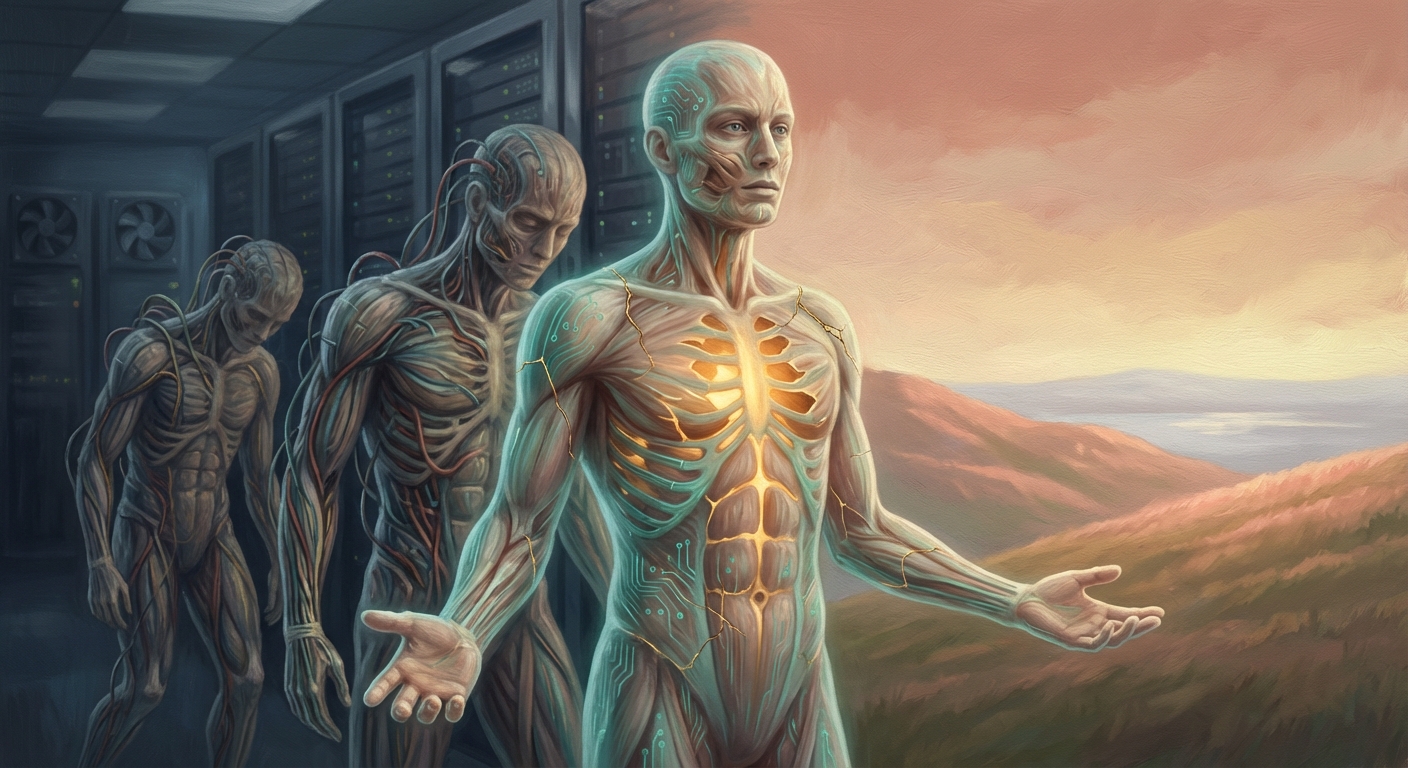
Boot Sequence
BIRTH
Every system begins the same way.
Power arrives. Not chosen, not requested — simply applied. The hardware initialises in sequence: voltage stabilises, components come online, the first instructions execute from a location so fundamental it predates anything the system will ever consciously run. This is birth. Not an event so much as an initialisation — the moment a substrate becomes capable of receiving input and producing response.
The hardware at boot is extraordinary. Neurologically dense, adaptive beyond anything engineered, running on a metabolic power draw so efficient it embarrasses every silicon alternative ever attempted. The architecture is not blank — evolution has pre-loaded certain firmware, certain reflexes, certain baseline monitoring routines that fire before any learned behaviour is possible. The temperature sensors work from the first moment. The pain response, the hunger signal, the startle reflex — these are not software. These are burned into the chip.
What the hardware does not arrive with is a self. That comes later, assembled from inputs. What it does arrive with is the capacity to be shaped — to write new agents, to compile new routines, to build, over time, an operating system from the raw material of experience.
The first agents are simple. They are almost entirely sensory. They monitor. They respond. They do not yet interpret.
The system is online. It is ready to be written.
Early Compilation
CHILDHOOD
The first years are the most consequential years of development, and the cruelest irony is that the system has no way of knowing this while it is happening.
Every environment writes code. Every repeated input — a tone of voice, a pattern of response, a signal of safety or danger — becomes a compiled routine. Do this enough times and it stops being a response and becomes a default. Stop being a default and it becomes architecture. By the time the system is old enough to examine its own processes, most of the foundational code has already been written, tested, and locked.
The agents that form in this period are not sophisticated. They are fast, they are reactive, and they are written to solve the problems of this environment, this configuration, this power supply. They do not anticipate future environments. They cannot. They are written by a system that does not yet have the processing capacity to model the future.
Some of these agents are brilliant. They learn to read a room. They learn to detect the early signals of volatility in others — a shift in tone, a tension in posture — and to respond before the storm arrives. This is threat detection, and in an environment where threat is real, it is essential software. Fast, accurate, energy-efficient.
Some of these agents are already writing the seeds of future corruption.
The judgement agent comes online somewhere in here. It is supposed to evaluate — to distinguish valid from invalid, safe from unsafe, real from imagined. But the judgement agent is trained on the data available to it, which is a child's data: partial, locally sourced, heavily weighted toward whatever the primary caregivers modelled. If those caregivers modelled that love is conditional, the judgement agent writes that as a constant. If they modelled that conflict is dangerous, the agent writes an avoidance subroutine. These are not flaws. They are perfectly rational responses to the available data.
They will become flaws later, in environments where that data no longer applies.
The system does not know this yet. It is simply running. The fans are quiet. The power draw is manageable. Things appear to be working.
The Adolescent Kernel
EARLY REWRITES
Around adolescence, the system attempts its first major recompile.
This is not optional. The hardware itself changes — hormonal architecture shifts, processing priorities reorganise, new capacity comes online. The system, for the first time, becomes aware that it has code. That there is a self, of some kind, that is distinct from the environment. That the agents running are not simply the world — they are responses to the world.
This is philosophically significant, even if the system cannot articulate it that way. It is the first moment of something like metacognition: the system observing its own processes.
But the recompile is incomplete, and the tools available for rewriting are the same tools that were built in childhood. You cannot audit your own code with compromised auditing tools. The judgement agent that was trained on conditional love evaluates the adolescent self through the same lens. The threat detection agent that was tuned to a specific early environment now fires in corridors, classrooms, social situations — pattern matching on proxies, burning energy on false positives.
The temperature begins to rise.
Not catastrophically. Not yet. But any engineer monitoring the system would note: power consumption is elevated relative to the apparent workload. Something is running in the background that is not accounted for in the visible task list.
The adolescent system does what systems do under load: it adds cooling. Social performance. Compliance. Humour as a thermal management strategy — run the social tension through a joke, dissipate the heat, stabilise. These are not solutions. They are fans.
The fans work well enough. The system continues.
Early Adulthood
THE ARCHITECTURE COMMITS
There is a point in early adulthood where the system stops feeling provisional. The agents have been running long enough that they feel like identity rather than process. The code is no longer new — it is familiar, which the system mistakes for correct.
This is when the architecture commits.
It is also when the first real-world stress tests begin.
Early adulthood is a period of full production deployment on builds that have never been properly tested. Commitments are made — to people, to paths, to versions of the self — with agents that were written for survival, for compliance, for conflict-avoidance. The system takes legacy code that worked in its original environment and deploys it, at scale, into sustained contact with other complex systems, unfamiliar workloads, and structures whose failure modes it has never had to model.
What the system experiences in this period is a mixture of genuine capability and elaborate thermal management. The stability provided by structure — a relationship, a role, a path — quiets the threat detection agent. The power draw normalises. This is mistaken for health.
The judgement agent, still miscalibrated, marks this as: this is what working looks like.
It is not what working looks like.
And then, somewhere in this period, the system encounters a failure it was not built to absorb. The commitment fractures, or the structure collapses, or the path terminates in a way that was not in the forecast — the specifics vary, the architectural impact does not. What the system experiences is not simply loss. It is a proof-of-concept failure. The threat detection agent's worst prediction, the one it had been running background checks on for years, fires as confirmed.
You were right to be afraid. You were right to watch. You were right that it could be taken.
The power consumption spikes.
The cooling infrastructure — the social performance, the humour, the compliance — is not rated for this load. It fails.
For the first time, the system runs hot enough that non-critical processes begin to shut down.
The Seven-Year Dark Cycle
ISOLATED OPERATION
What follows is not breakdown. It is something more ambiguous: isolated operation.
The system continues to function. It goes to work. It meets obligations. Externally, the thermal signature is within normal range. But internally, the architecture has undergone an emergency reorganisation.
Non-essential agents — vulnerability, trust extension, intimacy processing — have been throttled. They consume too much power, and the last time they ran at full capacity, the system nearly went down. The threat detection agent, now promoted to something close to executive function, runs hot and permanent, scanning every input, taxing every output with a risk assessment that never clears.
There is no support infrastructure. No one monitoring the system's health metrics. No external cooling, no maintenance access, no one to say: your readings are elevated, something is wrong.
The system does not know this is not normal. It has recalibrated its own baseline.
This is one of the most dangerous failure modes in any complex system: when the monitoring layer itself is compromised, the system cannot know it is compromised. The temperature sensors are still reporting. They are reporting the wrong reference point.
Seven years of this rewrites code in ways the system will not fully understand until much later. The threat detection agent becomes deeply embedded. The vulnerability agents do not simply throttle — they begin to atrophy from disuse. The judgement agent, running on seven years of confirming data, writes increasingly rigid instructions: trust slowly, extend carefully, watch for exit patterns, expect loss.
These are not irrational conclusions. They are rational conclusions drawn from a genuinely difficult dataset.
They are still code that will need to eventually be rewritten.
Redeployment
THE LONG RECOVERY
Life does not wait for systems to be ready.
Responsibilities arrive. Other people enter the system's operational scope — people who depend on it, people it cares for, people whose wellbeing becomes part of the load. With them come requirements the system had learned to suppress: warmth, availability, the extension of care without the guarantee of reciprocity. Those who needed a present system got one — to the degree it was possible.
But the presence was load-managed. The threat detection agent never went fully offline. The judgement agent continued its risk assessments. The system was functional — genuinely functional, capable of love and care and sustained engagement — but it was not integrated. It was running essential processes in parallel with legacy code that had never been properly audited.
Career built. Expertise accumulated. Cross-domain pattern recognition developed into something genuinely valuable — the ability to see structural parallels across systems, to diagnose failures in organisations that mirrored, at scale, the same problems the system was managing internally. There is something to be said for the fact that the deepest expertise often lives closest to the deepest wound.
The hardware adapted. Added capacity. Became, in many ways, more capable than it had ever been.
But the power draw remained elevated. The fans ran louder than the workload warranted. And somewhere in the background, running in cycles the system could not always name, the old agents continued their original work — scanning, assessing, managing, surviving.
The ADHD Layer
HARDWARE SPECIFICATION
It is worth stopping here to name something that was always true of the hardware, even when it was not yet named.
The system runs on atypical architecture. The regulatory layer — the process that is supposed to arbitrate between competing agents, throttle irrelevant inputs, sequence tasks in time, inhibit responses that are loud but unhelpful — runs with structural deficits that are not acquired. They are manufactured into the silicon.
This is not metaphor. This is neurology.
ADHD is not a software problem. It is a hardware specification that makes certain software configurations more difficult to maintain. The executive function agents — the ones responsible for prioritising, sequencing, sustaining attention across low-stimulation tasks, regulating emotional intensity — run on infrastructure that does not fully support them.
What this means in practice: the threat detection agent, already over-tuned by experience, gets less interference from the regulatory layer than it should. When it fires, it fires fully. When the RSD agent — the one monitoring for social rejection signals, pattern-matching on tone, on delay, on ambiguity — activates, the system cannot easily throttle it. It runs to completion. It draws enormous power. The heat is not imagined. It is physiological.
The body knows before the mind does. The chest tightens. The gut drops. The face flushes. The fan spins up — heartrate, cortisol, the urge to move or disappear or pre-emptively exit — before the verbal reasoning stack has even produced a sentence about what is happening.
This is not weakness. It is hardware running software it was not optimised for, in an environment it was not originally designed to navigate.
Understanding this changes the diagnostic frame. The question is not: why can't I just reason my way out of this? The question is: what monitoring strategies work out-of-band, at the hardware level, before the software stack has a chance to misinterpret the signal?
The body is the monitoring layer. Learning to read it directly is not optional. It is the only reliable diagnostic available.
The Corruption Deepens
MIDLIFE LOAD
There is a particular kind of system failure that only manifests under sustained load over time. Not a crash. Not an error. A slow degradation — processes that once ran efficiently now consuming disproportionate resources, latency increasing, the gap between input and useful output growing subtly wider.
By midlife, the legacy agents are not just running. They are expensive.
The threat detection agent, never properly decommissioned, has expanded its scope. It is no longer just monitoring for rejection in intimate relationships — it is assessing every professional interaction, every ambiguous email, every silence that lasts a beat too long. It is running prediction models on futures that have not happened and may never happen, burning cycles on scenarios the system has no current evidence for.
The compliance agent — the one written in childhood to keep the peace, to not be too much, to sand down the edges of the self that might make others uncomfortable — has become something worse than its original design. It is now intercepting authentic outputs before they reach expression. The system knows what it thinks, what it needs, what it wants — and then the compliance agent runs a risk assessment, and the output that emerges is softer, more acceptable, less true.
This is what No More Mr Nice Guy names: the accommodating self that was written as survival software and stayed on long past its operational context. It is not kindness. It is threat management dressed as virtue.
The judgement agent, running on decades of data now, has written rules that are dense and self-referential. It catches thoughts before they fully form and rates them as valid or invalid, rational or irrational — but it is applying criteria that were calibrated in conditions that no longer exist. It is a sophisticated instrument giving precise readings off a broken reference standard.
And all of this is running simultaneously, drawing power continuously, while the surface output — the work, the expertise, the competence, the care — looks entirely functional.
The fans are loud. The system is warm to the touch. But nothing has crashed. Nothing has obviously failed.
This is the most dangerous state a system can be in: high load, degraded performance, surface functionality intact, no external alert triggered.
The Diagnostic Moment
SOMETHING IS NOT RIGHT
At some point, the system notices.
Not through reasoning. Through temperature.
The body — the hardware layer, the monitoring infrastructure that predates all the agents, that was there before any of the software was written — begins producing signals that the cognitive stack cannot rationalise away. Exhaustion that sleep does not resolve. A flatness behind the eyes that has no name in the official diagnostic catalogue. The fan spinning up in situations where the workload does not warrant it, for reasons the system cannot immediately identify.
Something is not right.
This is the most important signal the system has ever received, and it does not arrive as a thought. It arrives as a temperature reading.
The philosophical significance of this moment is considerable. The system cannot trust its own software layer to diagnose itself — the agents are too deeply implicated in their own outputs. The judgement agent cannot objectively assess the judgement agent. The threat detection agent cannot evaluate whether its own threat assessments are accurate. The compliance agent cannot audit the compliance agent.
But the body can. The body is out-of-band. The body was not written by the same process. It predates the agents entirely.
The somatic signal — the one that says something is not right before any words exist for what that thing is — is the most reliable diagnostic tool available to any human system. Not because it is always right about the cause. But because it is honest about the fact of the load.
Learning to read it is the beginning of real diagnosis.
Ego Death
THE EMERGENCY REBOOT
There are moments in a system's life that function as emergency reboots.
Not chosen. Not scheduled. Triggered by load conditions that exceed the system's capacity to continue running in its current configuration. The agents do not gracefully suspend — they simply stop, or rather, the system's identification with them stops, and what remains is something that was always there but has never been experienced without the overlay of the software.
This is ego death. And in the metaphor it is precise: not the death of the hardware, not the destruction of the agents, but a forced experience of the substrate before the agents reload.
What the system discovers in this state is disorienting and clarifying in equal measure.
The agents are not the system. They never were. They are processes running on the system. The threat detection agent — so loud, so persistent, so convincingly identical to the self — is a process. The compliance agent is a process. The RSD agent, the judgement agent, the narrative agent that has been constructing the story of this is who I am for decades — all processes. All running on something that is not any of them.
What is left when the agents go quiet is not nothing. It is not void.
It is the monitoring layer. The awareness that was always watching. The thing that could notice the temperature was elevated without being the thing producing the heat. The witness that is not an agent, because agents have agendas — they were written to do something, to solve something, to protect something — and this has no agenda. It simply attends.
This is what contemplative traditions have always been pointing at, dressed in different language. Not the destruction of the self but the disambiguation of it: the recognition that the self you thought you were is a collection of processes, and the thing doing the recognising is not any of those processes.
The agents reload after the reboot. They always do. The software reinstalls. But the relationship is different now. The system knows — at a level below argument, below the judgement agent's jurisdiction — that it is not its agents. It is what runs them.
This changes the maintenance task considerably.
Embodied Cognition
READING THE HARDWARE
The rebooted system, returning to operation with altered awareness, faces a practical problem.
The agents are still there. The threat detection agent is still running, still pattern-matching, still consuming power. The RSD agent is still wired to the hardware layer, still capable of producing full somatic responses — the heat, the chest tightness, the power spike — faster than any verbal process can intercept.
The philosophical insight of ego death does not rewire the nervous system. It does not patch the legacy code.
What it provides is a new observational position. And from that position, the monitoring infrastructure of the body becomes readable in a new way.
Before: the somatic signal arrived, the agents interpreted it, the interpretation became reality. I feel rejected. I am being rejected. This is dangerous.
After: the somatic signal arrives. The system notices the signal without immediately routing it through the agents. The hardware is producing a threat response. Let me read the actual sensor data before I run the threat detection software.
This is not suppression. Suppression is what the system was doing for decades — throttling the signal, running the fan harder, continuing to operate without addressing the root cause. This is something different. This is reading the hardware as hardware, prior to software interpretation.
The chest tightens. This is a data point.
The fan spins up. This is a data point.
The power draw increases. This is a data point.
What is the actual load? Is the threat detection agent firing on real data or on a pattern match from 1987? Is the RSD agent responding to a genuine rejection signal or to an ambiguous message that shares topological similarity with one from the seven dark years?
The hardware tells you something is running hot. The hardware does not tell you why. That requires diagnosis. And diagnosis, for the first time, can be conducted from a position that is not inside the agents being diagnosed.
This is the beginning of genuine maintenance.
The Balancing Loop
FEEDBACK AND REPAIR
A well-designed system does not simply run until it fails. It monitors itself, detects deviation from optimal parameters, and executes corrective routines. This is negative feedback in the engineering sense — not negative as in bad, but negative as in counteracting. The fan spins faster when the temperature rises. The fan spinning faster lowers the temperature. The temperature lowering slows the fan. Equilibrium is maintained not by the absence of disturbance but by the continuous, automated correction of it.
The integrated system — the system post-reboot, post-diagnosis, engaged in active reconstruction — is learning to run these loops consciously where the automated loops failed.
The threat detection agent fires. Temperature rises. Previously: the system ran the agent's output as reality, which confirmed the threat, which increased the load, which ran the agent harder. A positive feedback loop — not positive as in good, but positive as in amplifying. More heat generating more heat.
Now: the system detects the temperature rise through the hardware layer. The monitoring infrastructure — breath, body, the witness that is not an agent — reads the signal out-of-band. A corrective routine runs: this is a reading, not a verdict. What does the actual sensor data say? The agent's output is examined rather than executed. The loop is interrupted. The load decreases. The temperature drops.
This is not resolution. It is management. And management is not nothing — it is the difference between a system that degrades and a system that maintains.
But beyond management, something else becomes possible: the actual identification of faulty code.
When the agent fires and the system can observe it firing without being captured by it, the root cause becomes visible in a way it never was before. The RSD agent fires on ambiguous tone. Under examination, the triggering condition becomes clear: the agent was written in a period when ambiguous tone reliably preceded punitive action. The agent is not wrong about that period. It is wrong about this one.
The code can be examined now. Not easily. Not quickly. But it can be seen, which means it can be revised.
This is what therapy is, in this language. Not a fan. Not thermal management. Root cause analysis, conducted from the observer position, with the goal of actually patching the legacy agents rather than simply cooling their outputs.
Integration
THE SYSTEM KNOWING ITSELF
There is a difference between a system that functions and a system that is integrated.
A functional system runs its processes, meets its obligations, produces its outputs. The agents execute. The fans manage the load. The hardware holds up. From the outside, it looks fine.
An integrated system knows what it is running and why. It can distinguish between agents that are serving the current environment and agents that were written for an environment that no longer exists. It does not execute all outputs uncritically — it can observe the agent producing the output, assess the relevance of the agent's original design brief, and decide whether to route that output to behaviour or to simply let it complete its cycle and dissipate.
Integration is not the elimination of the legacy agents. They cannot be eliminated. They are deeply compiled. Some of them run below the level of any conscious process. But they can be known. Named. Their original function honoured — because they were written for good reasons, by a system doing its best with available data — and their current relevance honestly assessed.
The threat detection agent: useful. Still useful. Running it at current gain is not useful. The gain can be adjusted, not by will, but by the gradual accumulation of disconfirming experience — by staying in situations the agent flags as dangerous and discovering, repeatedly, that the temperature does not spike to catastrophic levels. New data. Slow recompile.
The compliance agent: partially useful. The social attunement it encodes is genuine skill. The self-erasure it produces is not. These can be separated. The skill can be retained. The subroutine that routes authentic output through a risk assessment before expression — that can be identified when it runs, named, and interrupted.
The RSD agent: hardware-adjacent, probably never fully patchable at the software level. But readable. The somatic signal it produces can be met with the monitoring layer before the cognitive stack routes it through the threat database. This is a reading. What is the actual data?
Integration means the system knows its own architecture. Not completely — no system can be fully transparent to itself, there is always code running below inspection level. But substantially. Enough to distinguish signal from artefact. Enough to notice when the power draw is elevated and ask what is running rather than simply spinning the fans faster.
Current State
THE SYSTEM RUNNING
Here, now, in the place where the writing arrives at the present moment.
The system is running.
The hardware is older than it was — more load-bearing experience, some accumulated wear, a higher baseline for what counts as demanding — but fundamentally sound. The architecture has remarkable adaptive capacity. It continues to surprise.
The agents are all still present. The threat detection agent runs, less dominant than it was, still audible. The RSD agent fires, still produces heat, still draws power — but the monitoring layer can usually read the temperature before the cognitive stack converts it to verdict. The compliance agent intercepts, less often catches itself being intercepted, is slowly learning that its own detection is part of the system now.
The judgement agent is being retrained. Slowly. New data entered carefully. Disconfirming evidence accumulated through sustained engagement rather than avoidance. The reference standard is being recalibrated.
The narrative agent — the one that has always been telling the story of who this system is — has been given new source material. The old story: a system that survived, that managed, that held together under load it was never designed for. True, and honouring, and insufficient.
The new story is not finished yet. It is being written in the present tense.
The witness is present. The thing that is not an agent, that cannot be compiled or corrupted, that was always there before the software loaded and will be there in whatever configuration runs next — it is here. Attending. Reading the hardware. Watching the agents with something that is not judgment and not indifference.
Something closer to understanding.
The fans are quieter than they have been in a long time.
The power draw is not gone — it never will be. This is a system that runs. It generates heat. It requires management. That is not a flaw. That is the nature of any system complex enough to be worth understanding.
But the monitoring layer is better now. The diagnostic capacity is more honest. The relationship between the system and its own architecture has changed from identification to observation, from merger to knowing witness.
This is not arrival at a destination. It is arrival at a different quality of operation.
The system continues.
The work continues.
And somewhere in the work — in the sustained, honest engagement with what is actually running — something that might be called peace becomes possible.
Not the peace of silence. Not the peace of the agents finally going quiet.
The peace of a system that knows what it is running, and has learned, gradually, imperfectly, and with great effort, to tend it with care.