A companion to the essay
Power Shift Explorer
Six questions. Several possible futures. A way to examine assumptions without pretending that one chart can predict the whole system.
Start with a question
Select an axis to see what it means, what could move it, and which signs would be worth watching.
Compare assumptions, not reputations
Select one or more scenarios. Each panel compares one assumption on the same 0–10 scale. The labels stay beside the bars, so you can follow a scenario without tracing overlapping shapes. There is no overall score.
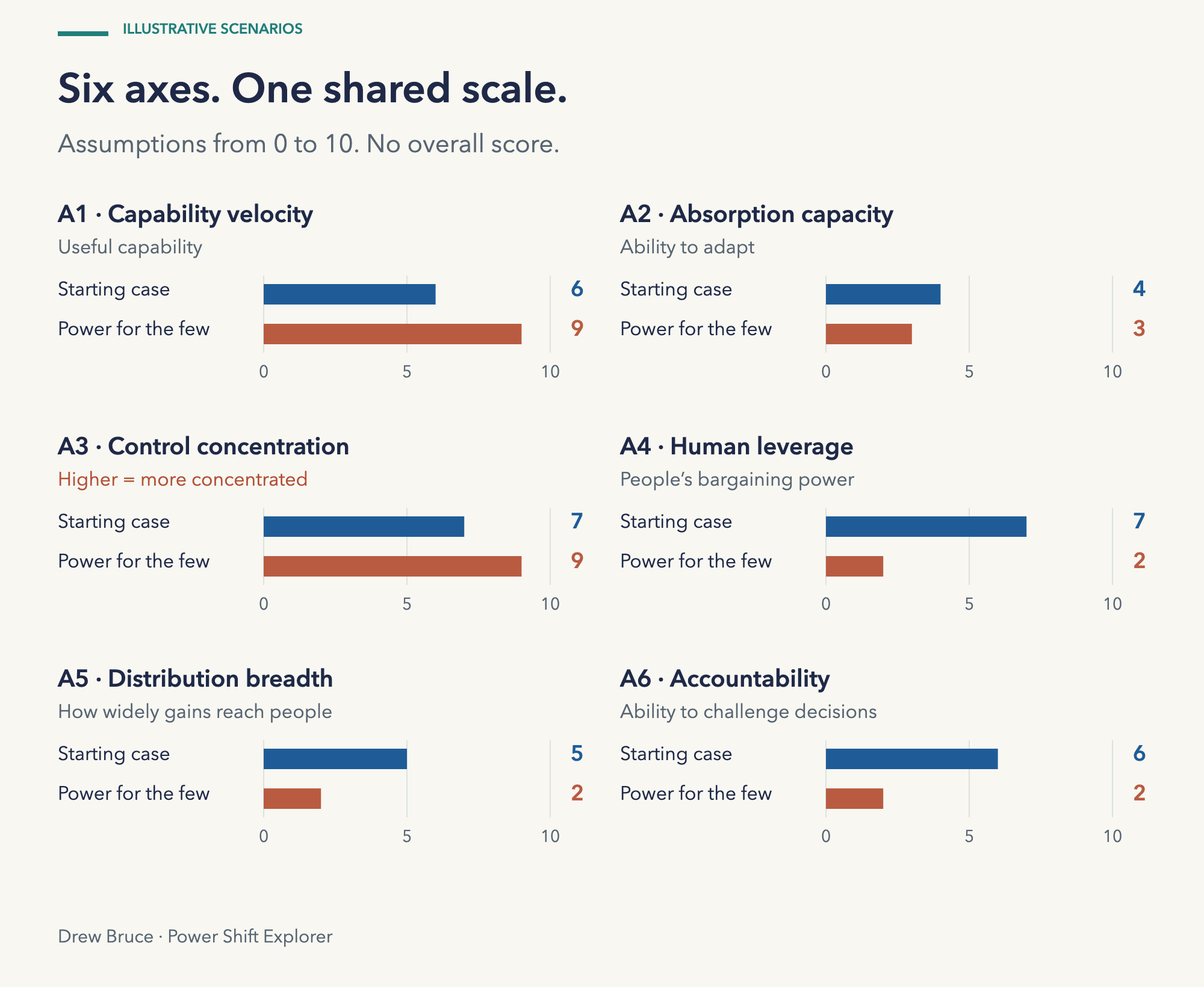
0–10 describes how much of a property is assumed. Higher concentration is not a better outcome. The starting case is illustrative, not an empirical 2026 baseline.
See the exact assumptions
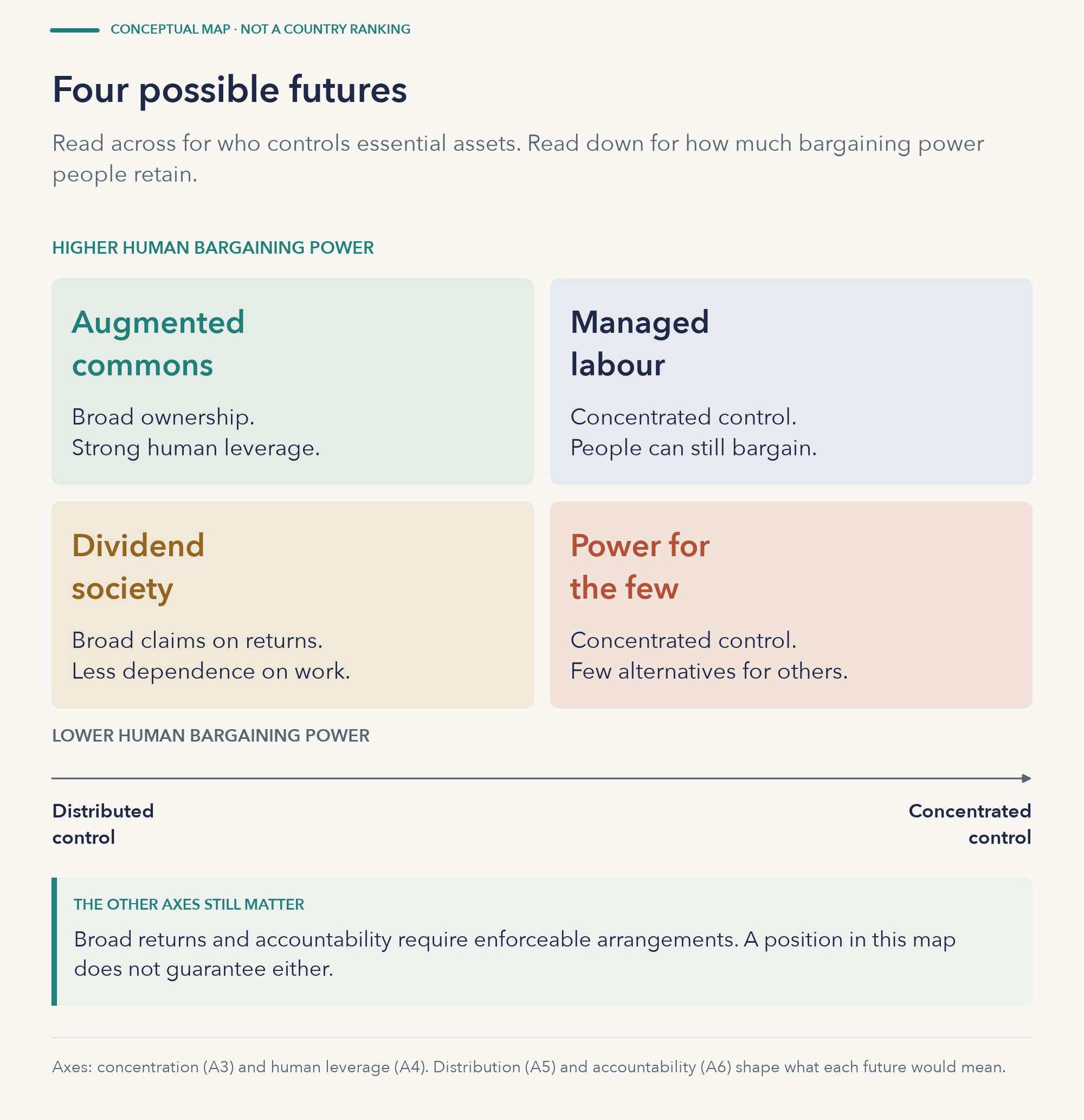
See the positions
The quadrant uses A3 and A4. The names also depend on A5 and A6, so position alone does not guarantee a dividend or an accountable commons.
Separate three rights
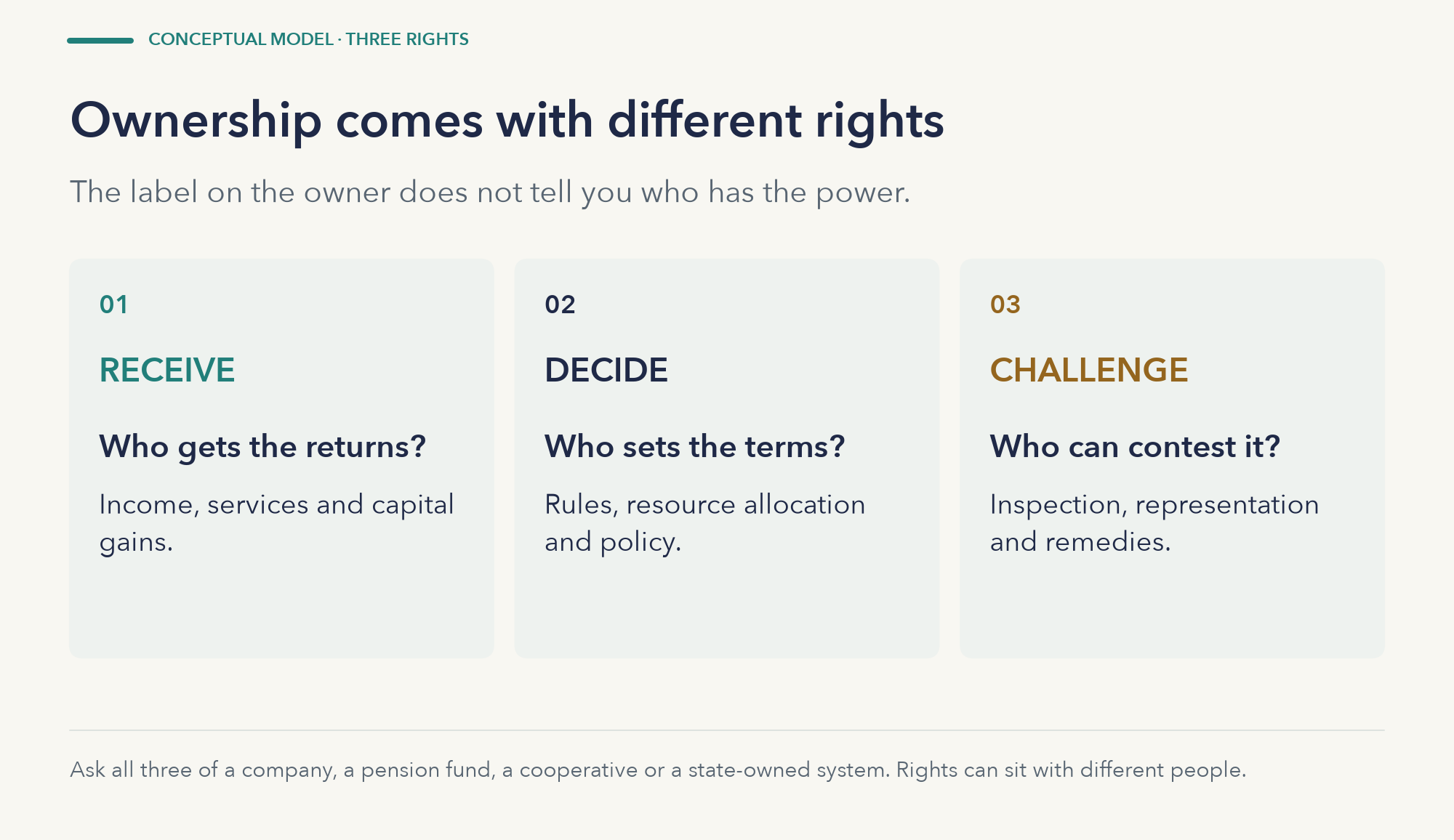
An ownership label leaves three questions unanswered: who receives the returns, who decides, and who can challenge those decisions? Private capital, the state and citizens overlap; neither a point in the middle nor an ownership label establishes democratic control.
Watch the clocks
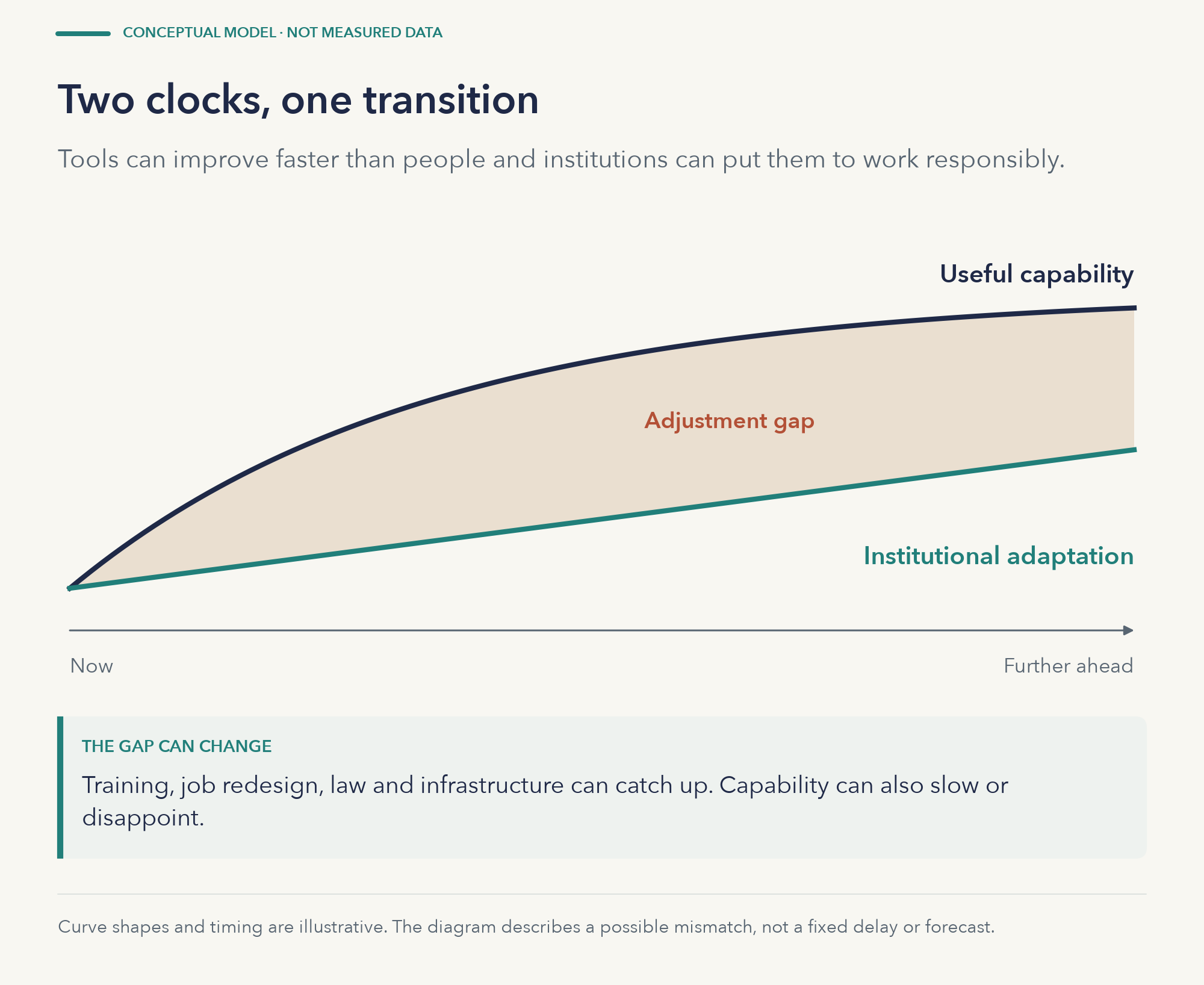
Capability and adaptation can move at different speeds. This is a hypothesis to investigate in each setting, not a universal three-to-five-year forecast horizon.
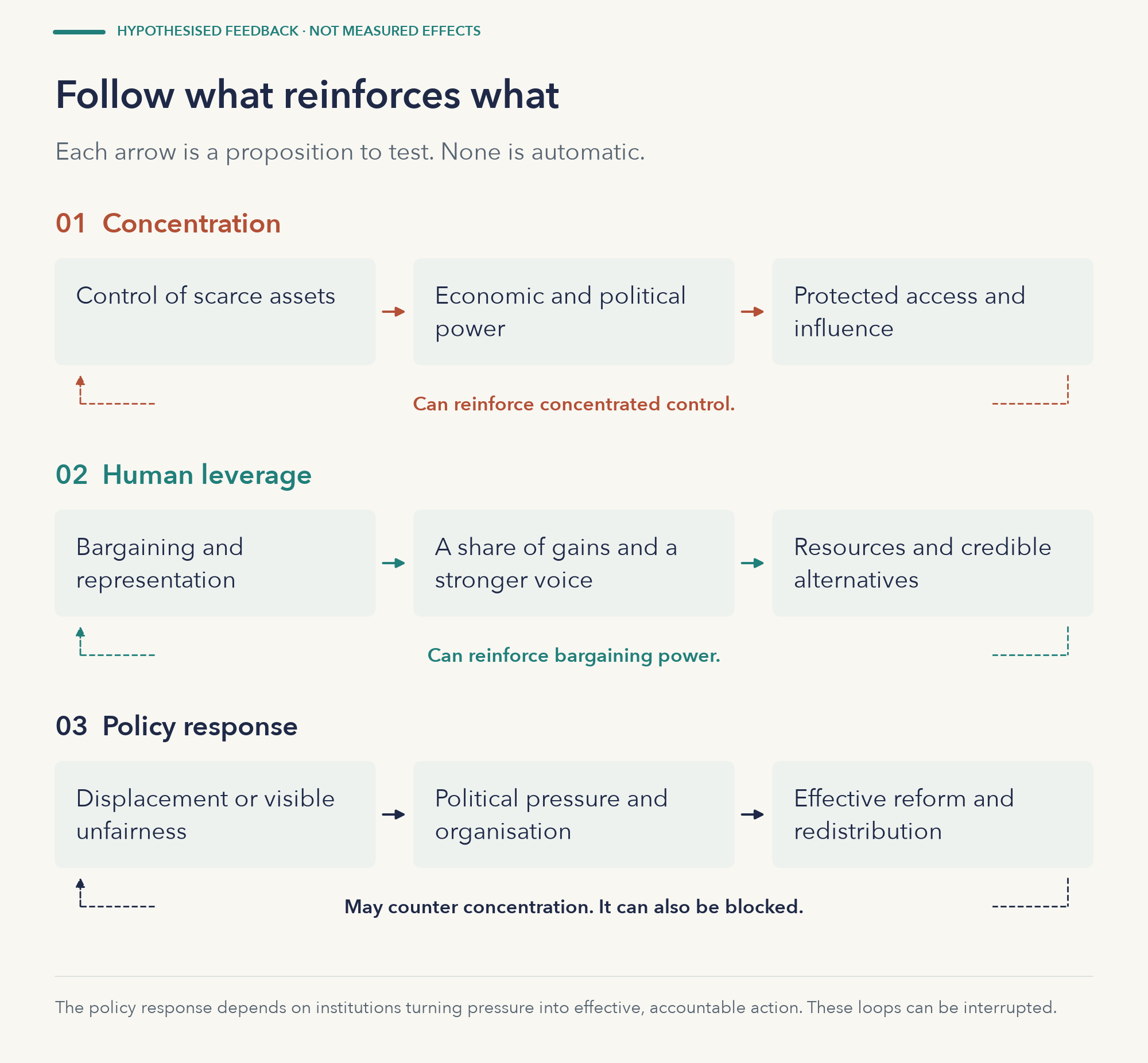
Follow the mechanism
Ask which arrows hold, where delays occur and what could interrupt each loop. Public pressure does not automatically become effective policy.
Follow the work and the money
A model can become cheaper and more widely used without gaining the same share of spending. This observed gateway snapshot illustrates that distinction. It does not measure profits or the whole AI market.
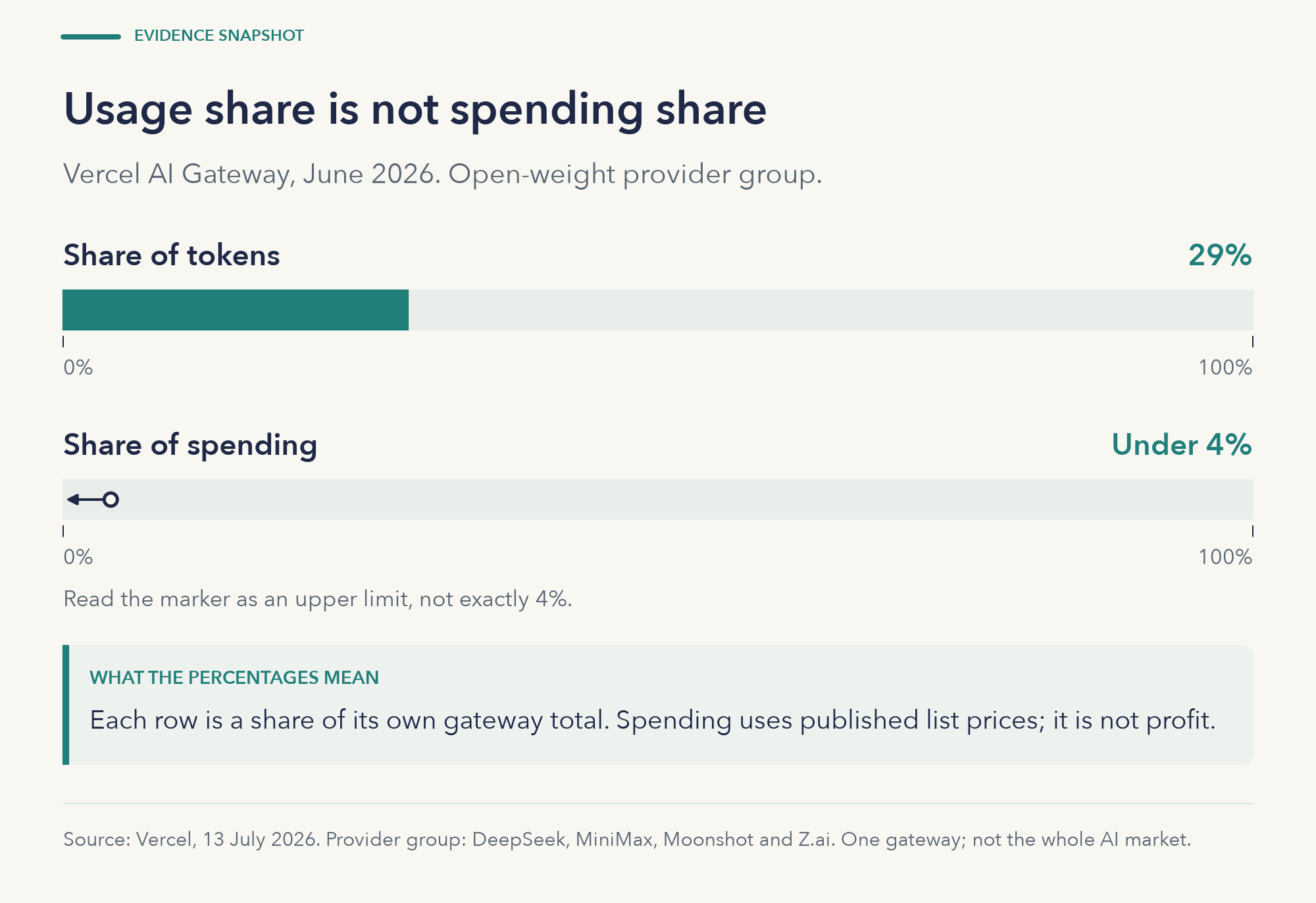
Source: Vercel's July index and methodology. Provider classification covers DeepSeek, MiniMax, Moonshot and Z.ai, not every open-weight model served through other providers.
The Forrester 2027 outlook adds questions across three axes. A2: can the organisation keep its business knowledge, skills and processes ready for agents? A3: can it move the model and the surrounding permissions, tool connections and work history? A6: can accountable people withdraw authority, inspect actions and respond to a challenge?
Model competition is a reason to test the concentration story. Lower switching costs across the whole service would be stronger evidence of reduced dependence than token share alone. The outlook's predictions do not validate the scenario scores here. Read the distinction between observations, forecasts and ownership in the essay.
Change the demographic starting point
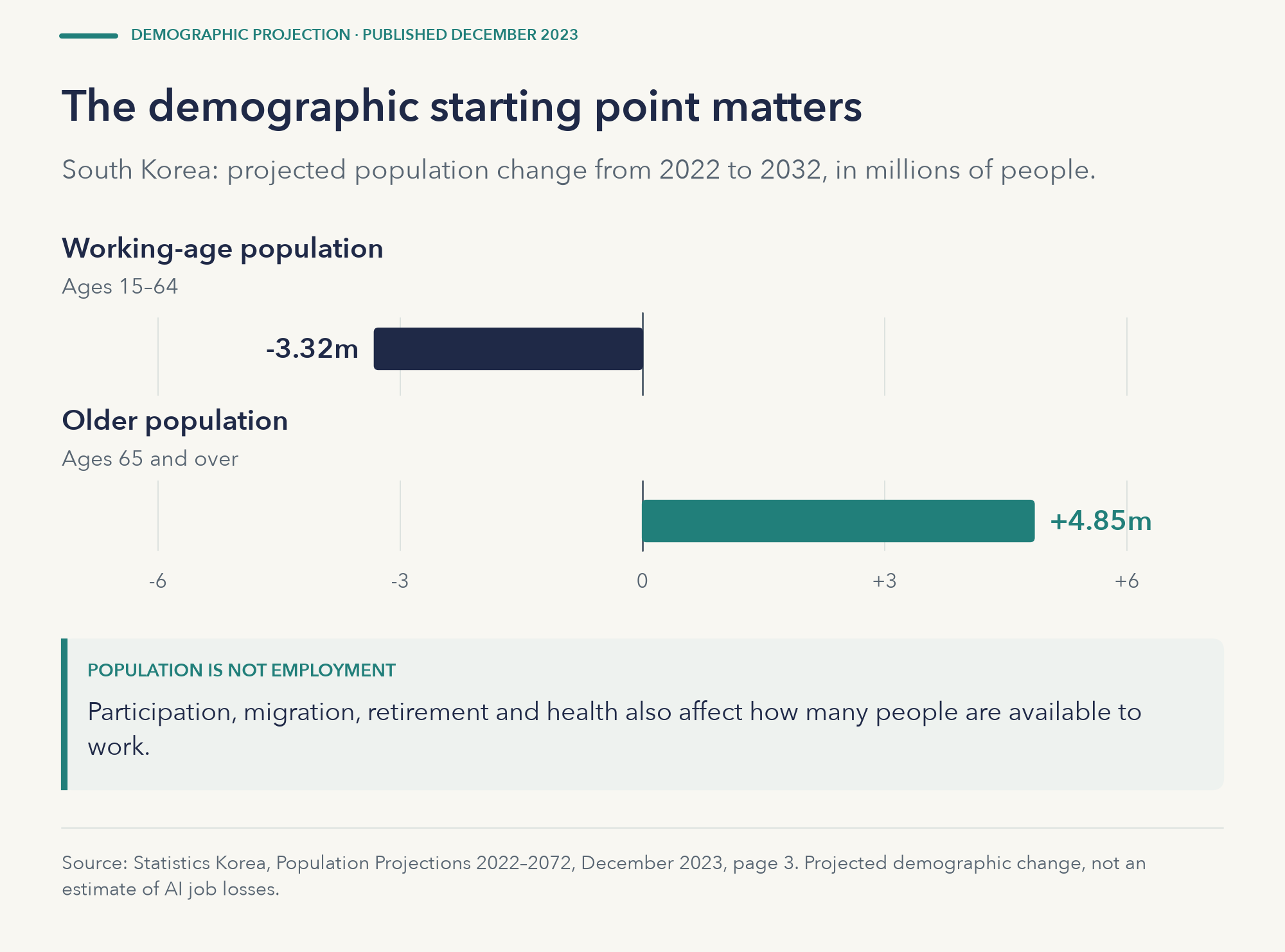
A shrinking working-age population can make AI a way to sustain services and output. That can coexist with displaced jobs in particular occupations. Demographics affect adaptation (A2), bargaining power (A4) and the route through which gains reach people (A5).
South Korea’s announced AI for All programme combines public services with a sovereignty goal. MSIT commits 512 Nvidia B200 processors for the initial services, budget funding from 2027, and domestic sovereign models for at least half of the service. This connects A3, control of the productive base, with A5, sharing the benefits. Domestic provision can reduce overseas dependence while control remains concentrated within Korean firms. It should not be scored as completed universal provision or citizen ownership.
There is a broadband precedent. Korea used public support and government purchasing to expand connectivity, with reported public-sector savings. For AI, test whether useful services and lower costs reach people, alongside income, ownership and control. The earlier programme does not guarantee the new one’s return.
Korea also has a position in an essential input: SK hynix and Samsung make high-bandwidth memory used alongside major AI processors. That gives their companies supply-chain influence; it does not establish that chip profits fund public AI. Australia has different starting points: land, energy, usable grid connections and critical minerals. Own the shovels we already have, then ask who actually controls them and who receives the returns. Read the evidence and Australian ownership test.
Source: Statistics Korea, December 2023 projection. Read the policy and demographic discussion in the essay.
A reference for revisiting the judgement
These are candidate signposts. Before scoring a country or organisation, define the measure, timeframe, source and comparison. Energy, geopolitics, demographic change and the meaning of work cut across all six axes.
| Axis | Contributing factors | Possible signposts | Interpretation trap |
|---|
A conceptual framework by Drew Bruce, 14 October 2026. Visuals and demographic context updated 15 October 2026. Scenario values are illustrative assumptions; the diagrams describe possible relationships, not measured causal effects.